
A lesson for India is to clearly define objectives beforehand, so that the adversary or other parties do not attempt to mitigate them midway.

Srivastava warned that continued bombing of Iran by the US and Israel could severely undermine any prospects of reopening critical maritime routes through negotiation with Tehran.

Vaibhav Sooryavanshi's explosive innings and Donovan Ferreira's late fireworks powered the Rajasthan Royals to a formidable total against Gujarat Titans in the IPL Qualifier 2.

The US torpedo attack on the Iranian warship IRIS Dena in international waters was a lawful act of war between belligerents, not a diplomatic or strategic embarrassment for India, asserts Vice Admiral Biswajit Dasgupta (retd).

The threat of wars hovers over the negotiations in Oman, but the good part is that Trump called the talks to be 'very good' and Iran's President Masoud Pezeshkian responded that they 'constitute a step forward', points out Ambassador M K Bhadrakumar.

The nine nuclear-armed states -- the United States, Russia, the United Kingdom, France, China, India, Pakistan, Israel and the Democratic People's Republic of Korea (North Korea) -- together possessed an estimated 13,080 nuclear weapons at the start of 2021.

After Operation Sindoor, the Army and Navy now view the IAF as not a supporting arm, but the spearhead of India's warfighting capability, capable of decisive outcomes across domains, explains Air Commodore Nitin Sathe (retd).
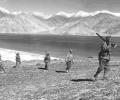
As India and China continue to face off across the Himalayas six decades later, the echoes of that earlier conflict remain unmistakable. The core of China's sensitivity lies not in maps or mountain passes, but in its perception of sovereignty over Tibet, points out Dr Kumar.
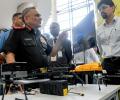
Chief of Defence Staff General Anil Chauhan emphasizes the importance of self-reliance in Unmanned Aerial Vehicles (UAVs) and Counter-Unmanned Aerial Systems (C-UAS) for India, citing recent global conflicts and Operation Sindoor as examples of their strategic importance.
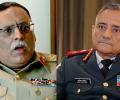
In the wake of the recent hostilities, both sides have moved from weapons to words, with India dispatching several delegations to visit more than 30 capitals across the world. A similar effort by Pakistan is set to start on Jun 2.
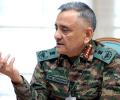
Chief of Defence Staff General Anil Chauhan on Saturday said India's Operation Sindoor has drawn a 'new red line' of intolerance against terror, and expressed hope that the military action has brought 'some lessons for our adversary also'.
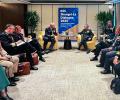
Top military officials from India and Pakistan highlighted their views at the Shangri-La Dialogue in Singapore, billed as Asia's premier defence forum, amid heightened tensions between the two sides following last month's military confrontation.
India has to fill in all the critical gaps in missiles, ammunition, sensors and stockpile in the fastest possible manner, focusing on the critical instruments that worked this time, asserts Shekhar Gupta.
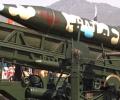
Pakistan is believed to have 140-150 nuclear warheads this year, 10 more than last year. In contrast, India is said to have 130-140 nuclear warheads, according to the annual nuclear forces data by Stockholm International Peace Research Institute.
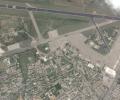
India's strikes on Pakistan damaged runways and structures across at least six airfields, according to a visual analysis by The Washington Post, which experts said were the most significant attacks of their kind in decades of simmering conflict between the two nations.

'If UAV technology is used by the adversary to target VIPs or strategic targets it would be a different ball game altogether,' says Group Captain Murli Menon (retd).

Israel needs to come terms with the new reality that they are no longer invincible or the dominant power in the West Asian region, observes Ambassador M K Bhadrakumar.
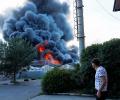
The current instability in the world is a result of long term systemic and socio-politico problems, points out Colonel Anil A Athale (retd).

'Kargil was Pakistan's strategic blunder. India must remain on guard against such sinister operations being launched in future by Pakistan's vengeful and devious military leadership that continues to have a hate-India mindset and the mentality of primitive warlords,' says Brigadier Gurmeet Kanwal (retd).
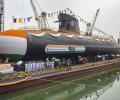
The status of the current submarine force level is alarming and we need to address the threat perceptions expeditiously. Critical decisions pertaining to national security cannot be delayed any further due to the rapidly changing maritime threat perceptions and growing strategic importance of the Indian Ocean region, asserts Commodore Venugopal Menon (retd).

Unlike Israeli company NSO, whose sale of Pegasus cyber tech grabbed worldwide attention, and other manufacturers of offensive-cyber products, Cellebrite operates in a grey area between security exports and civilian ones.
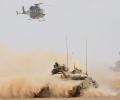
'Offensive operations to capture objectives across the LoC to eliminate terrorist launch pads and deny the use of the most dangerous routes of infiltration, are likely to be limited to brigade-level attacks.' 'These limited operations are unlikely to escalate to war across the international boundary,' says Brigadier Gurmeet Kanwal (retd).

In the test, a space rocket boosted a hypersonic glide vehicle, one capable of carrying a nuclear device, which circled the globe before impacting.
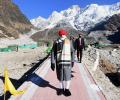
We understand the electoral compulsions, the desperate need for the BJP to have at least 50 per cent of the Hindus vote for them in Uttar Pradesh in a few months. For that, you need polarisation, put your own Muslim compatriots on the 'other' side. This is how your domestic politics runs contrary to your national, strategic interest, warns Shekhar Gupta.

December 3, 2021 marks 50 years since the beginning of the 1971 War which ended in a decisive military victory for India and the liberation of Bangladesh. Most analysts of the 1971 War agree that the IV Corps dash across the mighty Meghna river led by the brilliant General Sagat Singh was the turning point in the war, recalls military historian Colonel Anil A Athale (retd).

Overall, the People's Liberation Army Air Force (PLAAF) has focused on building ground-based air defense networks and network-centric operations rather than trying to match the Indian Air Force (IAF) in terms of straight fighter numbers along the border. All air assets fall under the Western Theater Command of the PLA, the largest geographic region of China's five military theater commands.

'The military aim in a future conflict, if it can't be avoided, should be to cause maximum damage to the adversary's war waging capability and capture limited amount of territory as a bargaining counter,' says Brigadier Gurmeet Kanwal (retd).
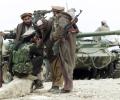
The current Indo-Pak crisis over Kashmir is a godsend for the US. With tensions running high, Pakistan is in no position to militarily help the Taliban. Once this realisation dawns on the Taliban, they are likely to be more amenable to a compromise on American terms, says Colonel Anil Athale (retired).

The Chinese air force is now a 400,000-person force that flies some 2,000 combat aircraft -- more than thrice the size of the Indian Air Force.
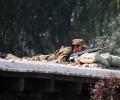
WWhat Pakistan faces in the Tehrik-e-Taliban Pakistan is virulent insurgency and terrorism, fuelled by its association with Al Qaeda
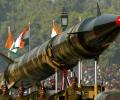
'We have worked to create road blocks in the path of those who thought that there was space for conventional war despite Pakistan's nuclear weapons.' 'Pakistan's nuclear weapons programme is not open-ended and aligned with India only.' 'In this unstable regional environment, one nuclear power is trying to teach lessons to another nuclear power through the medium of small arms and mortar shells on the Line of Control, and bluster.' 'A historic opportunity of a lifetime beckons the leaderships of India and Pakistan to grasp, sit together and explore the possibilities of conflict resolution.'

'With two nuclear neighbours, how likely is it for our armed forces to battle in a contaminated environment that could include nuclear, biological or chemical attacks by the adversary?' 'Are we prepared for the threat?' Brigadier S K Chatterji (retd) explains the meaning and significance of Operation Vijay Prahar.
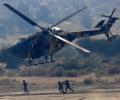
'Given the present force levels, India cannot fight and win.' 'India can't hope to terminate the conflict on India's terms and impose the nation's will upon the adversaries,' says Brigadier Gurmeet Kanwal (retd).
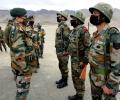
'India is not the India of 1962. We are not carrying that baggage of history anymore.'
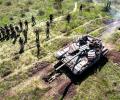
'As long as we have such partners, Russia cannot be isolated.'
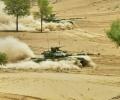
'Even if your soldiers are Sunny Deol and Vicky Kaushal, Pakistanis are no Johnny Walkers.' 'The one lot who never takes them lightly is India's professional soldiers.' 'That's why they keep winning the real wars,' says Shekhar Gupta.

'Pakistan's security establishment, despite its appallingly immoral approach to conflict, has worked with limited resources to maximise its national defence resources to continue bleeding India,' says Ajai Shukla.

'China's latest defence White Paper has been issued against the backdrop of the upgraded Sino-Pakistan strategic relationship which has impinged on India's sovereignty and territorial integrity, and Beijing's continuing intransigence on tackling the issue of the disputed border or intrusion by PLA troops,' says Jayadeva Ranade.

The time is over when United States President Barack Obama thought he could afford to make a joke about the ISIS.

'It would not be incorrect to say that the Chinese-Pakistani strategy of containing India began in the aftermath of the 1965 war.'
